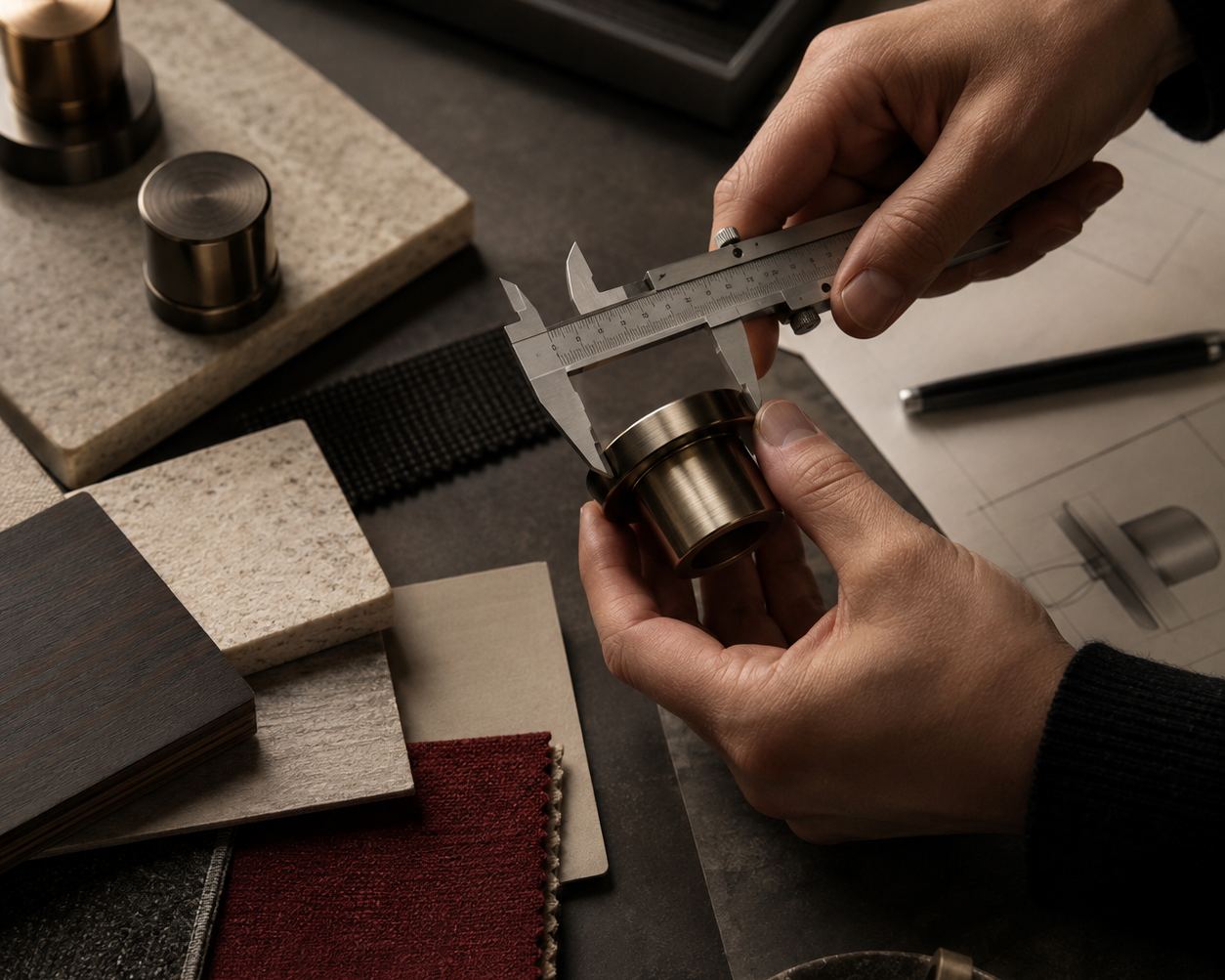
The sample is your real contract with the factory. The agreement sets what you pay and when, but the sample is what sets how the product will look — and when a gap turns up between what arrived and what you expected, the approved sample is the only thing you can point at. That makes the sampling stage not a preliminary step but one of the most important stages in the whole process.
The trouble is that most importers order a sample in order to be impressed. A sample ordered to impress always will, because the factory knows exactly what it is for. A sample ordered to be measured is a different story.
Three kinds of sample, and do not confuse them
- Stock sample. An existing catalogue product the factory sends as it is. It is useful for getting a sense of general finish quality, not for approving your product.
- Custom sample. A product made or modified to your request. This is the one you approve, and it is the one that costs money and time.
- Production sample. A unit taken from the line of the order itself, after it has started. It is the closest thing to what will actually arrive, and it is how you verify that no material was quietly substituted.
What to send the factory before asking for a sample
A good sample starts with a good request. The vaguer the request, the more the factory fills the gaps with its own assumptions — and they will always lean towards the cheaper option.
- Exact dimensions, with the permitted tolerance on each one.
- Material: not "quality plastic" but a specific material grade.
- Target weight. Weight is the simplest way to discover that material thickness has been shaved.
- Colour by an agreed colour code, not by a screenshot.
- Finish: gloss, matte, texture, coating.
- Function: what the product has to do, and under what load.
- Packaging — if it is part of the sample, and in most cases it should be.
The first round is almost never right
That is normal. Three rounds is an ordinary state of affairs, sometimes more. What matters is not that the first round be perfect but that every round produce measurable feedback. Instead of writing "the colour is off", write which colour arrived, which is required, and what the colour code is. Instead of "feels cheap", write what wall thickness arrived and what is required.
Every round should end in a numbered list of corrections, not a paragraph. A numbered list can be walked line by line in the next round; a paragraph can be interpreted.
Measure it, do not admire it
When the sample arrives, take it out of the box and measure it. This sounds obvious, and almost nobody does it the first time.
- Measure every dimension that appeared in the specification, with a rule or callipers, and write the result down.
- Weigh the product and compare it against the target weight.
- Compare colour in daylight rather than artificial light, and against the colour code rather than against memory.
- Operate the product the way a customer will operate it, not gently.
- Check the parts that tend to break: hinges, lids, joins.
- Photograph everything, including what is fine. Those photographs are the basis for comparison later on.
The approved sample
Once you reach a sample you are happy with, it becomes the standard — but only if you make that explicit. The approval procedure is simple and it matters:
- Confirm in writing, explicitly, that this sample is the standard for the order.
- Mark it physically and keep it. One copy with you, one copy with the factory.
- Photograph it from every angle and keep the photographs with the date.
- Write into the agreement that the order will be measured against the approved sample, and that any change of material or subcontractor requires prior approval.
That last clause is the one that prevents the most common scenario of all: the factory changes a raw-material supplier mid-order, because its price went up, and mentions it only if asked.
What it costs, and who pays
Samples cost money, and the factory charges for them — sometimes for the express shipping too. That is legitimate. What is worth settling in advance is whether the cost of the samples is credited against the first order, and that is an entirely standard request most factories agree to.
What is not worth doing is skipping samples to save money. The cost of three rounds of sampling is a small fraction of the cost of a whole order that arrived wrong — and unlike that order, it can be corrected.
Further reading
Run the sampling stage properly
If you are in the middle of sampling rounds and not getting to a result, the problem is usually in how the feedback is written rather than in the factory. Tell us what is happening.